1936 Poughkeepsie Regatta
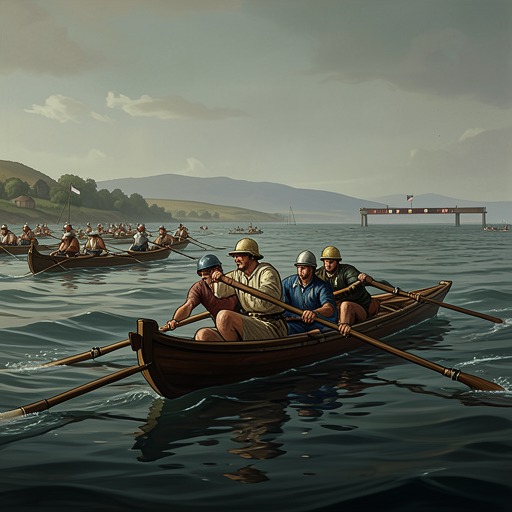
The Boys in the BoatThe 1936 Poughkeepsie Regatta turned the Washington crew’s late-race surge into a national sporting drama and brought its working-class rowers to the threshold of the Berlin Olympics. After winning earlier races, Washington’s varsity crew came from behind to pass California in the final 200 yards, making the Huskies national champions and placing the university on the brink of sweeping the regatta. The triumph also exposed how fragile an Olympic opportunity could be: within hours, Washington learned that the crew might have to finance its own journey to Germany.
A regatta shaped by history and unequal access
The Intercollegiate Rowing Association’s regatta at Poughkeepsie had long been a major stage for American rowing. The sport had drawn national attention since the nineteenth century: the first collegiate crew race, between Harvard and Yale, took place in 1852, and the 1869 Harvard–Oxford race helped kindle further interest. By 1929, as many as 125,000 spectators came to Poughkeepsie, while millions more followed the races by radio. For colleges, a strong crew could confer national prestige as well as victory.
That prestige had not been distributed evenly. Eastern universities had dominated the regatta through much of the early twentieth century, while western crews faced the expense of transporting boats and rowers across the country and the condescension of spectators accustomed to seeing the sons of political and industrial elites. Washington’s first appearance under Hiram Conibear, in 1913, ended in third place, and the university secured the West’s first Intercollegiate Rowing Association victory in 1923. By 1936, the rivalry between Washington and the University of California, Berkeley had helped draw large western audiences, but the western programs still had fewer resources and patrons than their eastern counterparts.
The race’s social boundaries were visible beyond the Washington–California rivalry. Earlier that month, Australian policemen had been excluded from the Grand Challenge Cup at Henley because the rules barred competitors who worked for wages in occupations classed as manual labor. The exclusion sent the Australians to Berlin determined to compete there. In contrast, the British Olympic crew came from the prestigious Leander Club and from the rowing ranks of Oxford and Cambridge. Poughkeepsie thus formed part of a wider sporting world in which competitive standing was entangled with class, money, and access.
Washington’s earlier wins
Washington’s victories in the races before the varsity contest raised the stakes for the day. In one race, Washington began at a comparatively restrained rate of thirty-two strokes per minute while Navy and California moved ahead. The crew stayed close, gradually passed Navy, and then edged in front of California beneath a railroad bridge at the one-mile mark. California surged past near the finish, but Washington answered with a final increase to thirty-nine strokes per minute and won by a full length. The result also meant that Tom Bolles, who had been weighing a possible coaching offer from Harvard, would leave Washington after his boys came through for him.
Washington’s junior-varsity crew then followed with another measured race. Navy and Cornell initially moved ahead, but Washington held its position without raising its rate. After allowing the early leaders to spend their energy, the crew increased its pace to thirty-seven strokes per minute and steadily opened the distance. It finished three lengths ahead of Navy. These victories made a Washington sweep possible, while California still had the chance to win the varsity race for a fourth consecutive year and secure a third successive Olympic berth.
The varsity comeback
In the varsity race, California held a commanding position with less than a mile remaining. Al Ulbrickson, watching from the observation train, believed Washington had fallen too far behind and was using too much of its strength. The turn came from coxswain Bobby Moch, who called a succession of hard efforts for Ulbrickson, George Pocock, and the rowers’ parents. One of Moch’s calls falsely suggested that California was directly ahead; the orders kept the crew working as Washington moved past Columbia and began to close on Navy.
With half a mile remaining, Washington was still third and two lengths behind. Moch called for the crew to go, and Don Hume raised the stroke rate through thirty-five, thirty-six, and thirty-seven. Joe Rantz followed Hume’s rhythm, and the boat began to move with the coordinated swing that carried it past Navy. In the final 200 yards, the rowers reached forty strokes per minute and passed California. The Huskies crossed the line with open water between their stern and the bow of the California boat.
The finish changed the atmosphere from near defeat to astonishment. Ulbrickson resumed chewing his gum; Pocock celebrated loudly; and Bolles waved his battered fedora in the press car. In Seattle, Hazel Ulbrickson and her son Al struck a glass-topped coffee table until it shattered, while Mike Bogo set off seven bombs from the automobile bridge. The rowers pumped their fists in the darkness. Ulbrickson later acknowledged that Moch had known what he was doing, though the coxswain’s initiative had also tested the coach’s authority.
Victory, recognition, and the cost of Berlin
Washington left Poughkeepsie as national champion, having swept the Hudson’s races that day. Newspaper accounts described the varsity victory as a landmark in the regatta’s history and emphasized its nerve, psychology, and rowing intelligence. On the return upstream, Ulbrickson saw the crew rowing with the precision that had become its strength. His teasing question about why they had not rowed that way during the race carried a serious reminder: the team still needed to beat Ky Ebright’s California crew again to earn its place in Berlin.
The celebration was quickly interrupted. At the annual banquet, each rower found a purple necktie and a five-dollar bill at his place. Later that evening, Henry Penn Burke told Ulbrickson, Pocock, and Washington athletic director Ray Eckman that the crew would have to pay its own way to the Olympics. The American Olympic Committee was short of funds, but Washington had not expected the winning crew’s passage to be in doubt. Burke demanded $5,000 by the end of the week and warned that Penn could take Washington’s place.
The demand exposed the gulf between the crew’s new national stature and its members’ means. Washington had already scraped together money from alumni and Seattle residents to reach Poughkeepsie and Princeton; its rowers were working-class Americans, not heirs able to cover an overseas journey. The city mobilized in response. Volunteers sold fifty-cent tags, civic leaders solicited donations, and contributions arrived from Seattle businesses and the rowers’ home communities. Don Hume’s Olympia sent $299.25, Joe Rantz’s Sequim sent $75, and towns associated with other rowers also gave. After the first day, the tag drive had raised $1,523; by the second, the Seattle Chamber of Commerce chairman had sent a certified check for $5,000.
With the money secured, Washington could prepare to travel as the United States’ eight-oared Olympic rowing team. The Poughkeepsie victory had made the crew famous, but it had not erased the financial barriers that shaped access to elite sport. Its achievement was both athletic and collective: a disciplined comeback won the race, while the response at home helped make the next race—selection for Berlin—possible.